
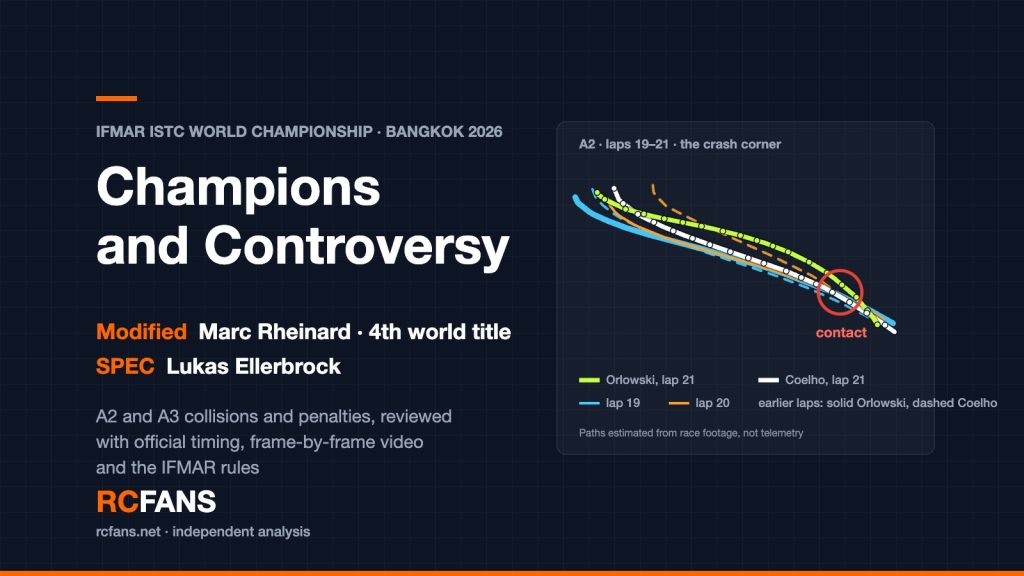
RCFans race report and independent analysis
On 14 November 2026, the IFMAR ISTC 1/10 Electric Touring Car World Championship finished at Huge RC Circuit in Bangkok, Thailand. Germany's Marc Rheinard won the Modified class, taking his fourth electric touring car world title. Jin Sawada finished second and Michal Orlowski third. In the SPEC class (13.5T stock motors), fellow German Lukas Ellerbrock won the first two A-mains and sealed the title with a race to spare (the best two of three A-main results count).
Key points
Champions: Modified – Marc Rheinard (fourth world title); SPEC – Lukas Ellerbrock.
A2 contact: On lap 21, with about 17 seconds left, Bruno Coelho made contact with race leader Michal Orlowski, whose car rolled.
Penalty: Coelho first received a 5-second penalty; after A3 this was changed to a one-lap deduction, dropping him to tenth in A2 and ninth overall.
A3: Coelho retired after an opening-lap incident; Orlowski won A3 and finished third overall.
RCFans' view: the available evidence is not enough to conclude that any driver in A2 or A3 caused a collision on purpose.
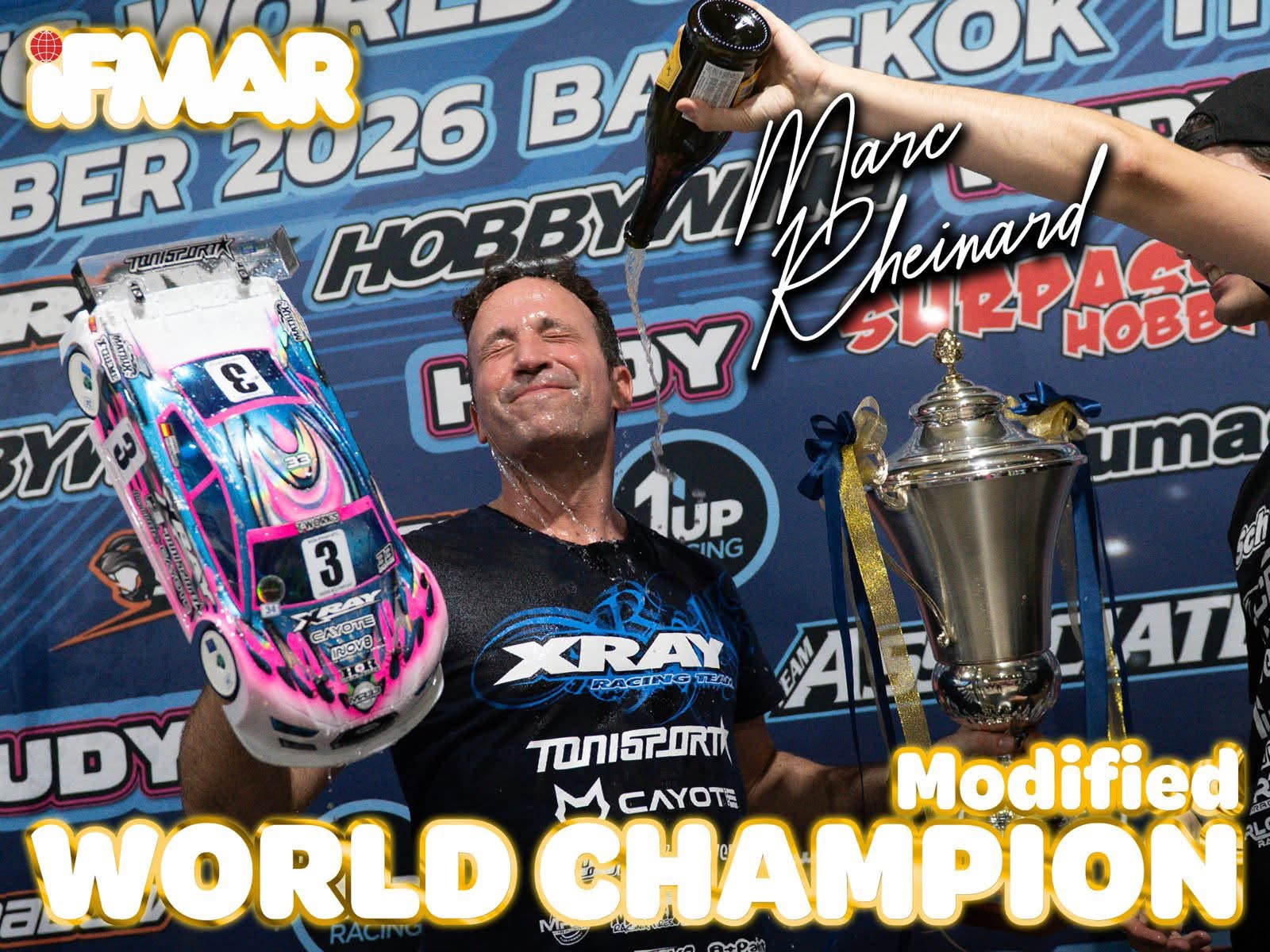
Both German winners have a story worth telling. At the same time, the collisions and penalties in Modified A2 and A3 (the second and third A-mains) left this World Championship with plenty of debate.
After reviewing the official timing, race footage, the rules and driver interviews, RCFans has reached the following view:
The available evidence is not enough to conclude that any of the drivers involved in A2 or A3 caused a collision on purpose. Driving responsibility and the basis for each penalty still need to be examined case by case.
We respect every driver's effort to compete for results, and we apply the same standard to their actions and to their explanations. The starting point is what happened on track and how the rules deal with it.
Rheinard's fourth world title
From his first title at Kissimmee, Florida, in 2004 to Bangkok in 2026, Rheinard's electric touring car world titles span 22 years. His previous title came in 2010, 16 years ago, and he turned 40 this year.
In a post-race interview, Rheinard said he was delighted to win the world title again. Although he did not take TQ (top qualifier) in any single qualifying round, he felt he had been competitive throughout. Having joined XRAY this year, he won at his first World Championship with the team, and he thanked the team for working together and his mechanic Stefan for preparing the car for every race.
Modified qualifying went down to the final round. Orlowski set the fastest time in Q6 (the sixth qualifying round) by 0.085 seconds to take overall TQ, and with it pole position for the A-mains. Bruno Coelho started second and Rheinard third.
In A1, Orlowski led with Coelho close behind. Orlowski ran wide at the end of the straight, then hit the kerb and rolled; Coelho won, with Rheinard and Sawada second and third. The footage shows no contact between the two cars before the roll, and Orlowski explained afterwards that the car became hard to control after running wide and ended up hitting the kerb.
The incidents and penalties in A2 and A3 then reshaped the title fight. With the best two of three A-main results counting and the lowest points total winning, Rheinard took the title on 3 points with second in A1 and a win in A2. XRAY teammate Sawada was second overall; Orlowski finished third overall with a win in A3 and fifth in A2. Coelho's final position was ninth.
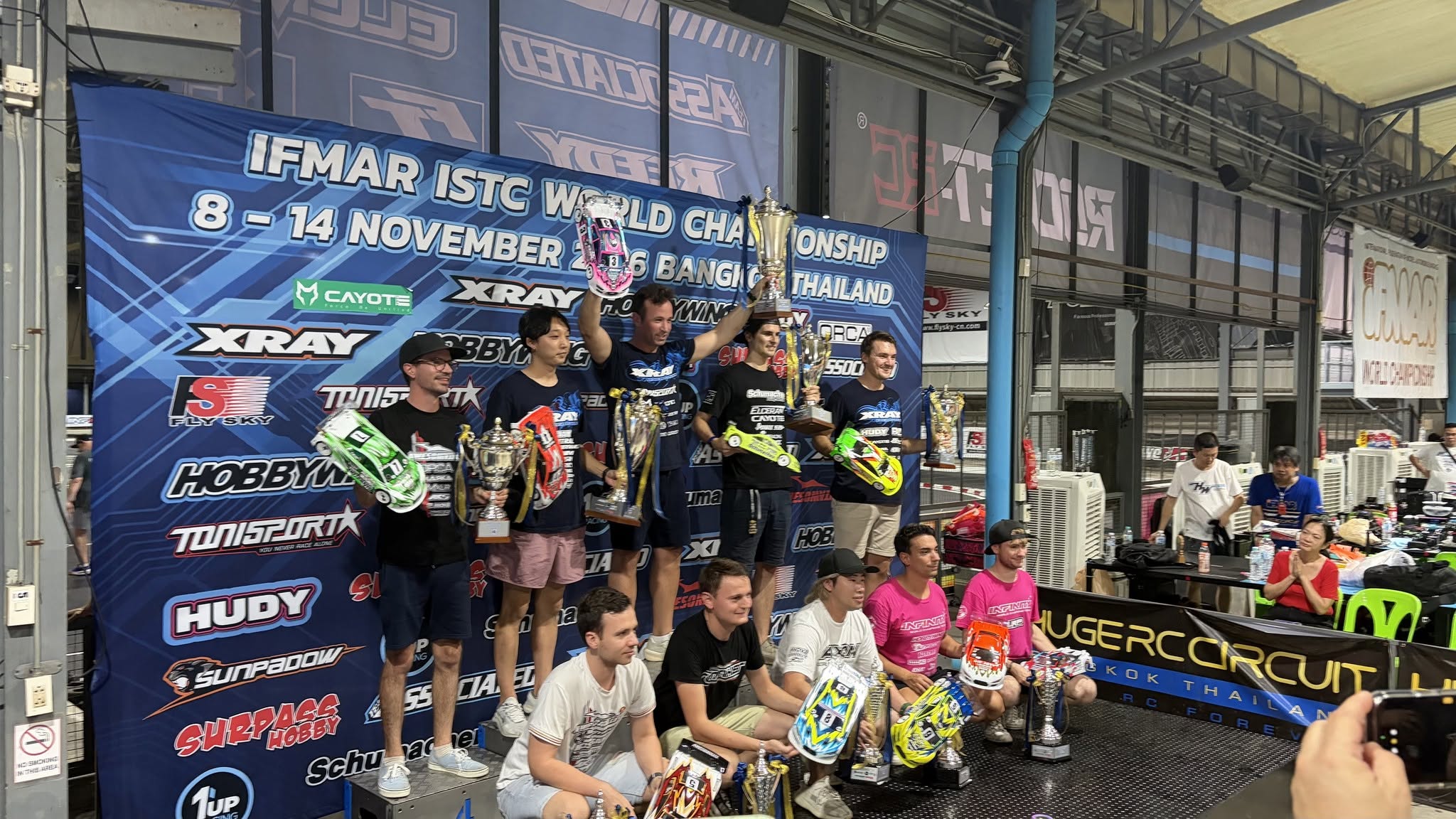
Modified A-main drivers on the podium
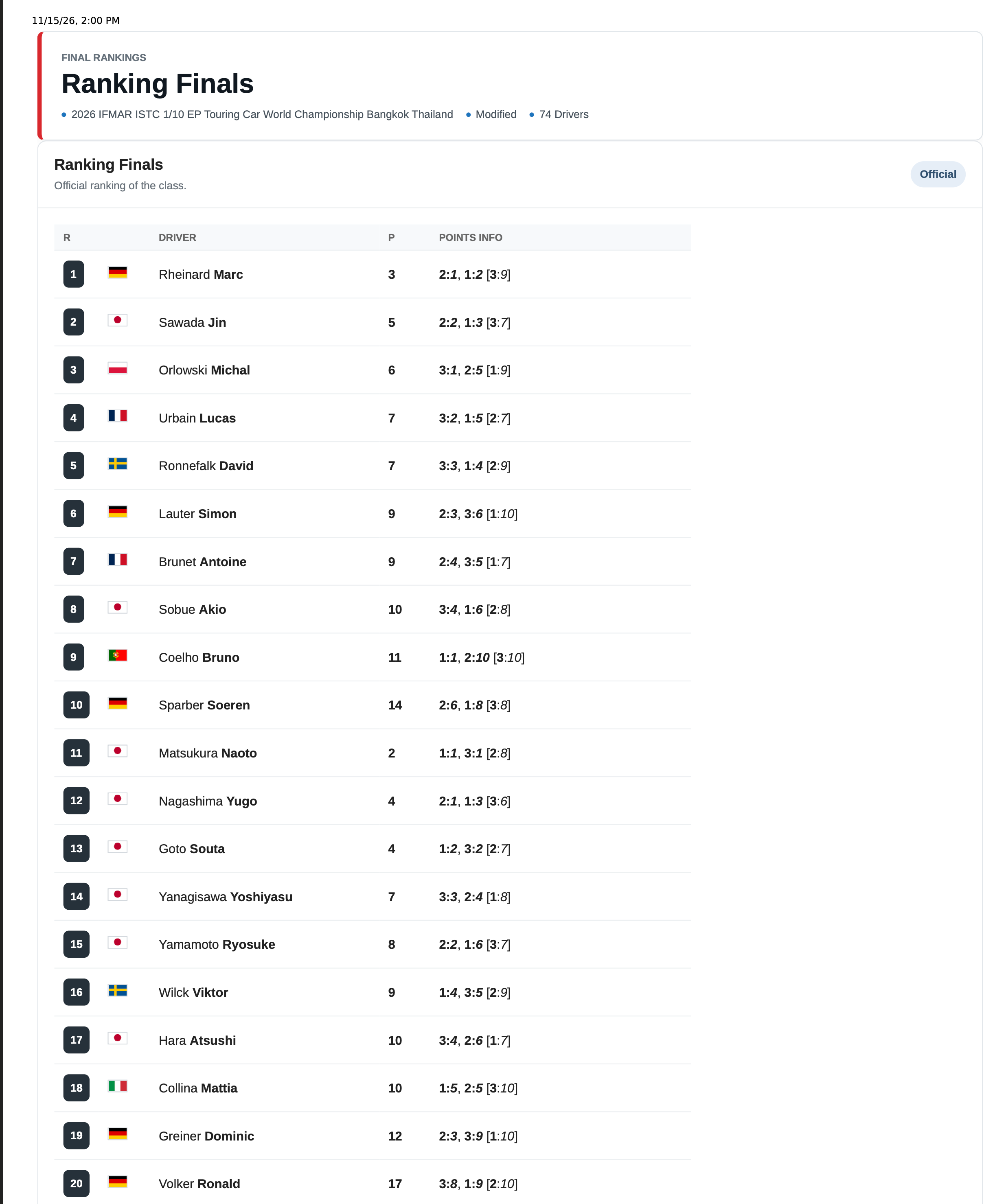
Modified final ranking | Source: MyRCM official results
Contact with about 17 seconds left in A2
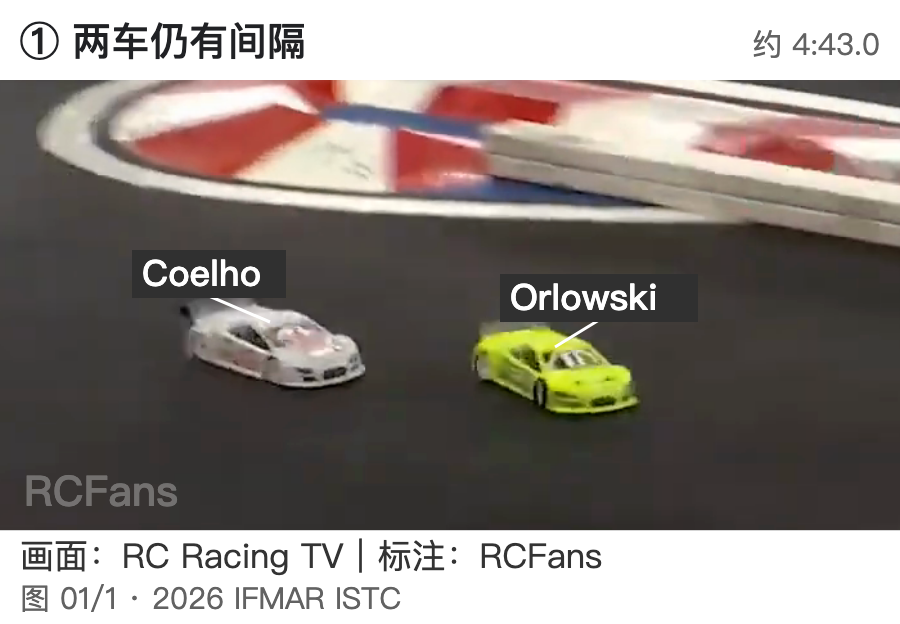
The key incident in A2 came on lap 21, with about 17 seconds of the five-minute race remaining. Orlowski led with Coelho right behind; at the previous crossing of the timing line the gap was just 0.104 seconds.
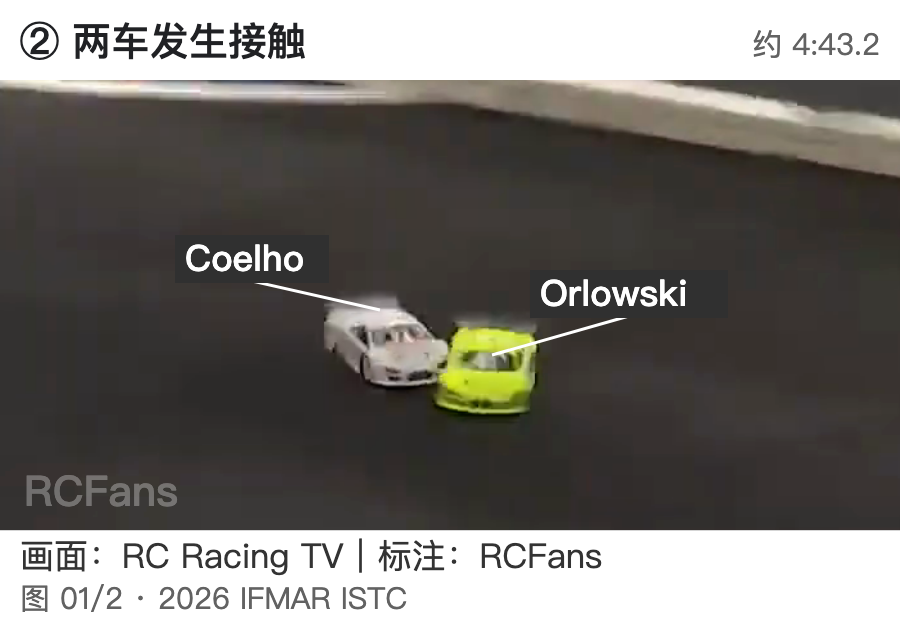
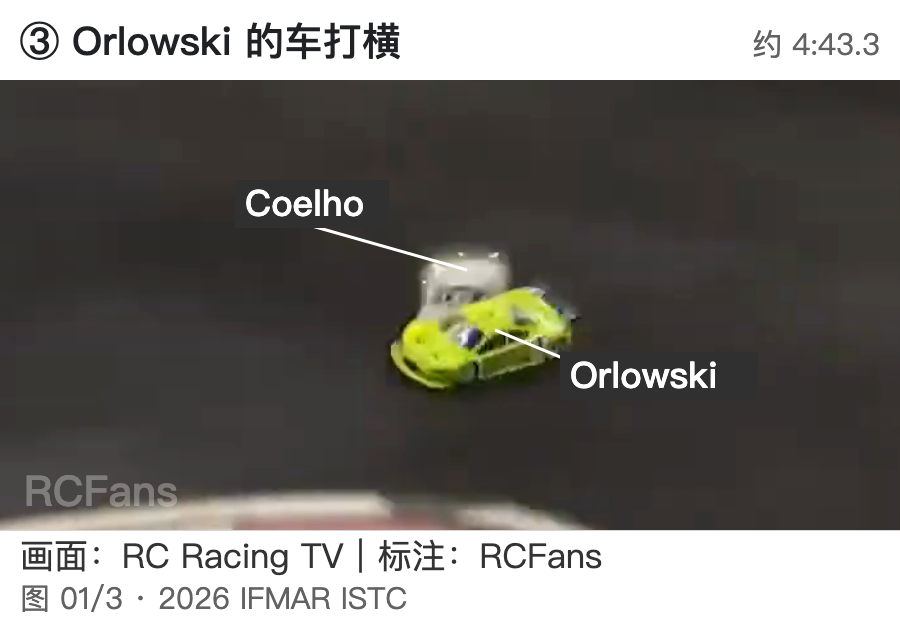
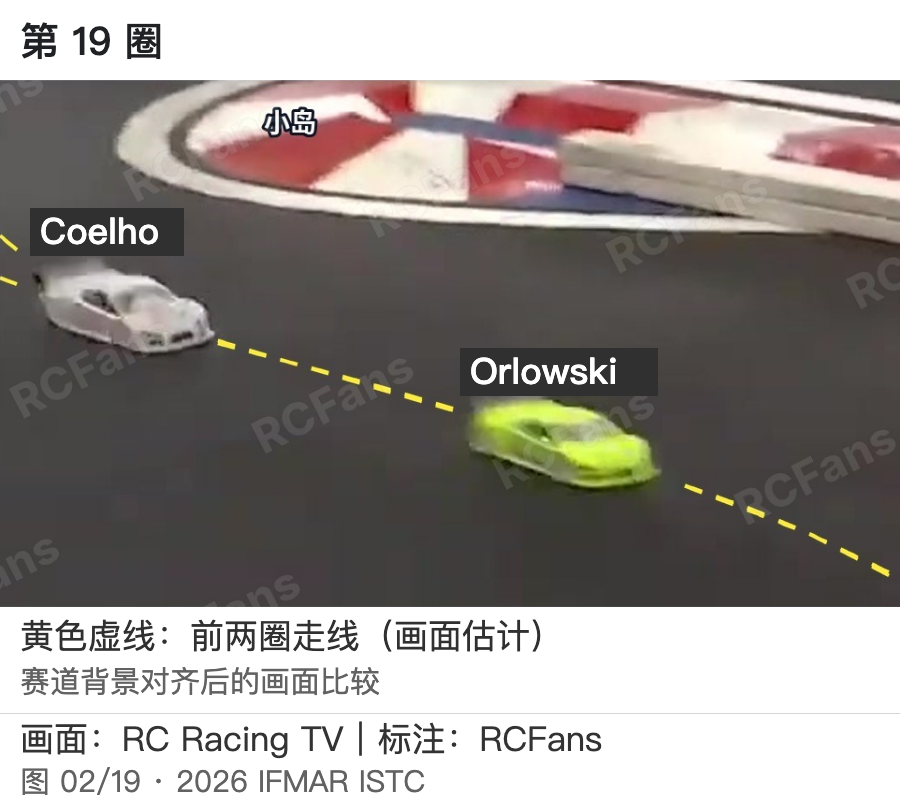
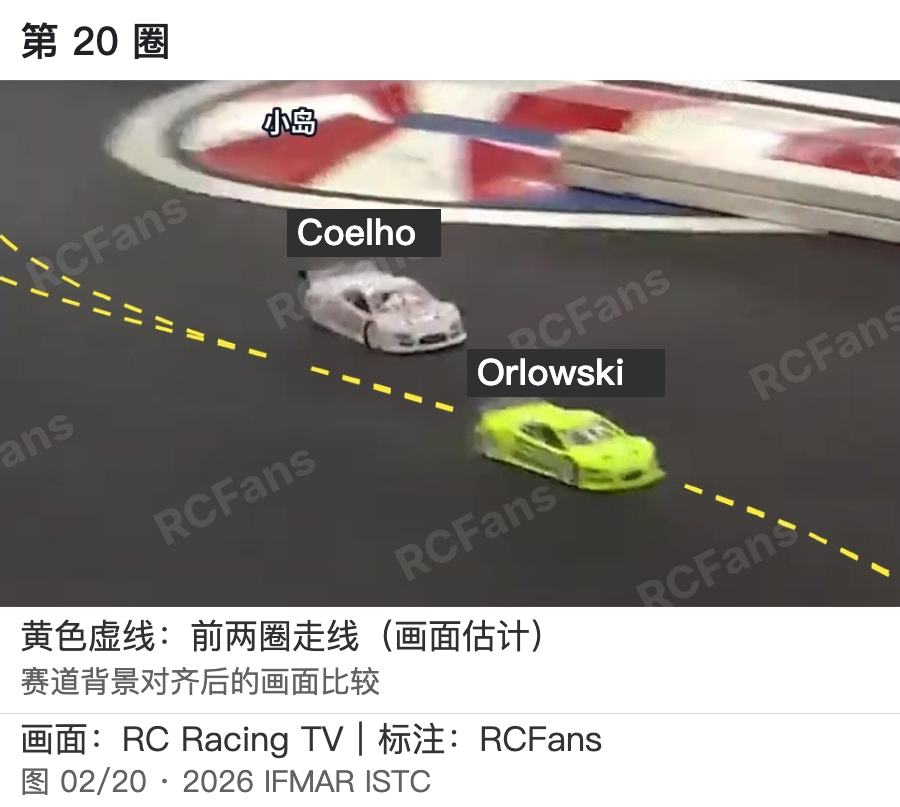
Exiting the hairpin beside the island, Orlowski's car was closer to the island than on the previous two laps, and in consecutive frames it moved forward a little more slowly. Coelho closed in from behind and to the side. Orlowski then moved back towards his earlier line and the two cars touched: the front of Coelho's car hit Orlowski's right rear, and Orlowski's car turned sideways, hit the kerb and rolled.
① Still a gap between the cars · about 4:43.0 into the race
② The cars make contact · about 4:43.2
③ Orlowski's car turns sideways · about 4:43.3
④ Orlowski's car rolls at the kerb · about 4:43.5
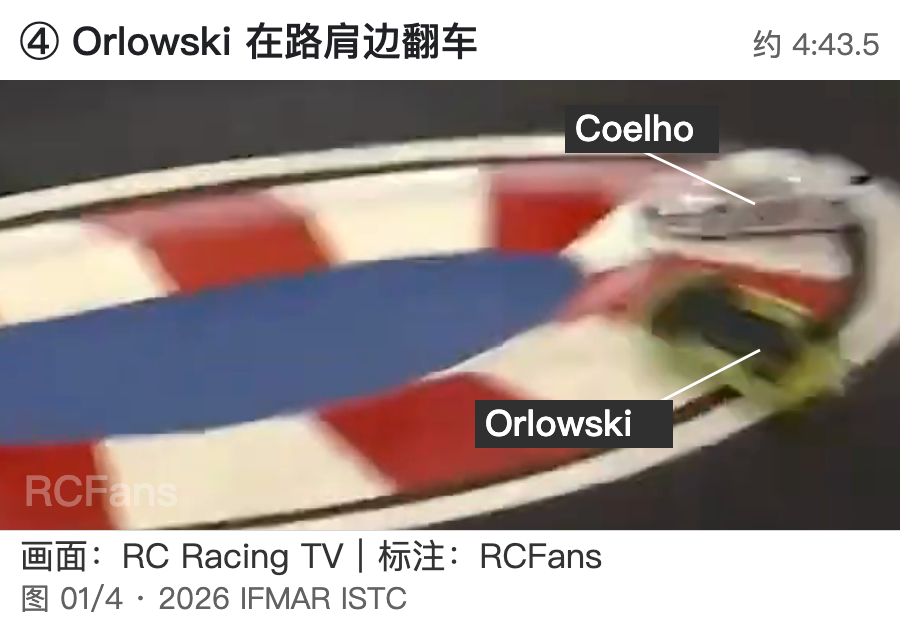
Figure 1 | Within about half a second the cars go from close to contact; Orlowski's car then turns sideways and rolls near the kerb. Panels are in time order. Labels in the images are in Chinese; the captions give the English.
Coelho continued and crossed the line first. Orlowski resumed after the roll, completed lap 21 and then stopped by the outside barrier, classified fifth in the race. He said afterwards that the collision had pulled the body shell in and damaged the front of the car, making it very difficult to carry on.
Lap 19
Lap 20
Lap 21: closer to the island
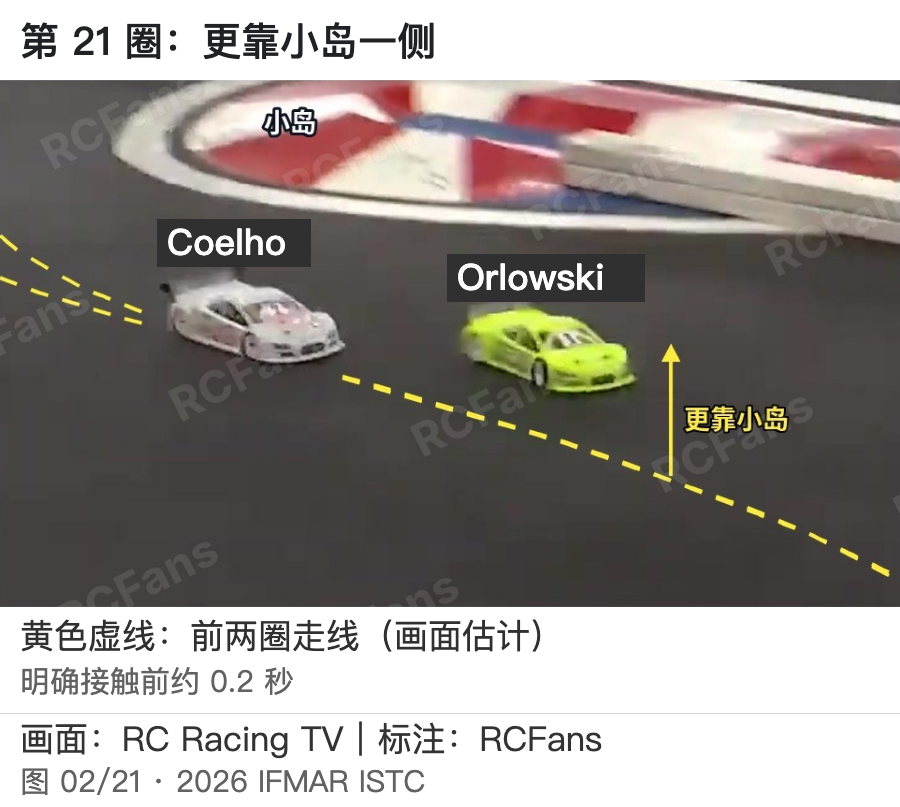
Figure 2 | The same corner exit on laps 19, 20 and 21: on the crash lap Orlowski's car is closer to the island. The yellow dashed line joins the estimated car positions from the previous two laps. The frames are aligned on the background, but camera position and car attitude still affect the comparison.
The two drivers explain the contact differently. Orlowski acknowledged that the rear of his car had become loose and lost grip late in the race, but said this was no reason for the car behind to run into him. Coelho said he saw the rear of the car ahead slide out and tried to pass on the inside; he does not accept that every contact following a mistake by the car ahead should be blamed on the car behind.
RCFans' view: the available evidence is not enough to conclude that Coelho hit Orlowski on purpose.
Judging by his approach, Coelho's move can be read as an overtaking attempt. But misjudgement, excessive risk or failing to avoid contact while overtaking can also warrant a penalty. Even if Orlowski's car was unsettled at the time, that does not entitle the car behind to drive into it.
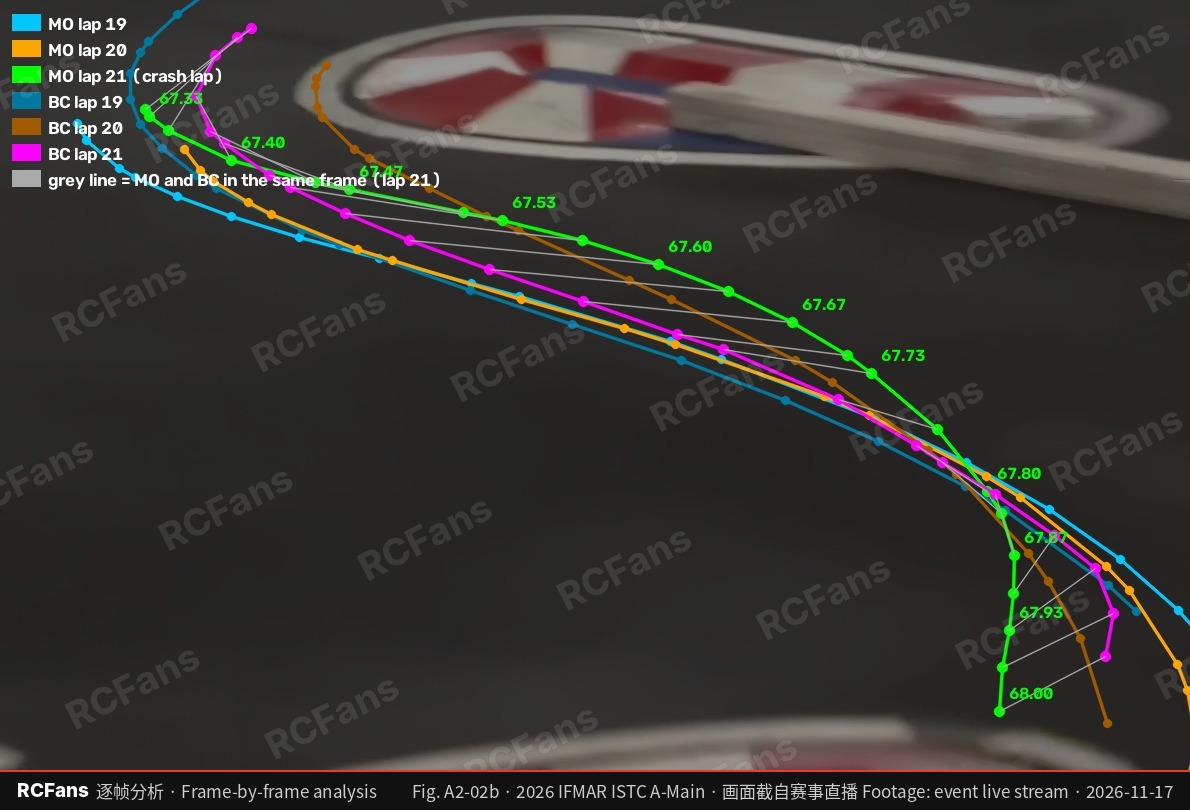
Paths of both cars on laps 19, 20 and 21 of A2 (MO = Orlowski, BC = Coelho). Each dot is one frame; green numbers are the video time code in seconds, with clear contact at around 67.77 s; grey lines join the two cars in the same frame. Paths are image estimates, not telemetry | Footage: RC Racing TV | Analysis: RCFans
Whether Coelho lifted or braked, and whether he could have avoided the contact, is a central question in this dispute. With a single camera angle, limited image sharpness and no throttle, brake or steering data, the evidence is not enough to give a definite answer.
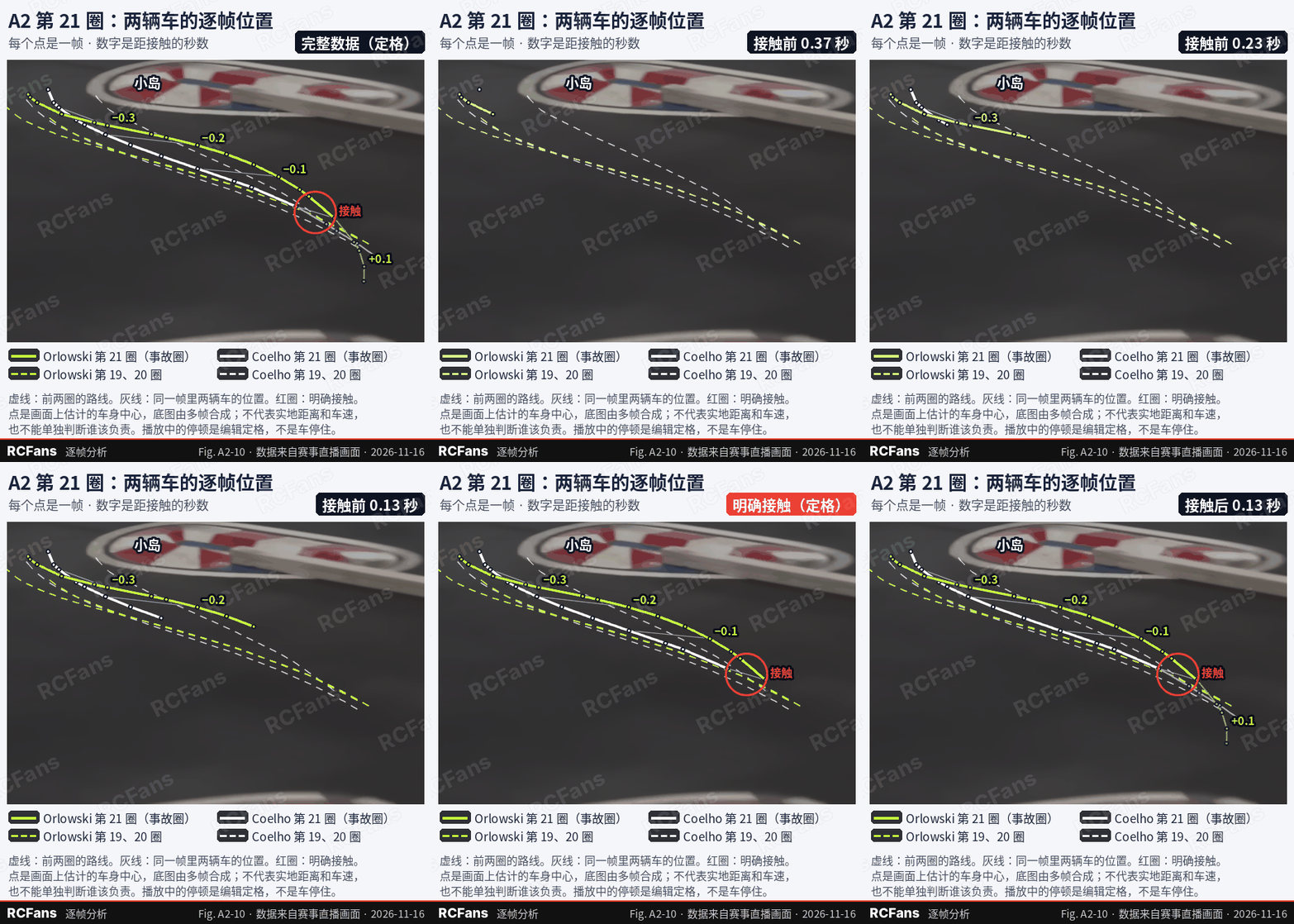
Frame-by-frame positions of both cars on lap 21 of A2; numbers are seconds relative to contact | Footage: RC Racing TV | Analysis: RCFans
Leading does not mean an unlimited right to the line
RCFans does not accept that a car's line is automatically legitimate just because it is in front. IFMAR General Rule 1.15.1 already lists impeding other competitors, deliberately slowing down or waiting with the intent of impeding or hitting another car, deliberate crashing and reckless driving among the matters for the referees. These rules apply to the leading car as well. IFMAR General Rules, rule 1.15.1
A driver attempting to overtake should judge the space and do everything possible to avoid contact; equally, the car in front cannot use its position to excuse improper blocking or dangerous moves. Responsibility for a collision should be judged on how both lines changed, how the contact happened and whether there was a chance to avoid it, not simply on who was in front.
At the same time, normal braking into a corner or correcting a slide should not be treated as deliberate blocking merely because it affected the car behind, and a mistake by the car in front does not automatically clear the car behind. These principles apply to every driver involved at this event, but they do not in themselves show that anyone committed a deliberate infringement in A2 or A3.
Lap times show how close it was
Coelho and Orlowski were very closely matched in the first two A-mains. Taking the complete laps before each race's main incident, the three drivers' average lap times were as follows; the short run from the start to the first crossing of the timing line is not included.
| Laps compared | Coelho | Orlowski | Rheinard |
|---|---|---|---|
| A1, laps 1–16 | 13.756 s | 13.757 s | 13.864 s |
| A2, laps 1–20 | 13.817 s | 13.826 s | 13.917 s |
Over these two stretches Rheinard was about 0.1 seconds per lap slower, and the lead was mainly contested by Coelho and Orlowski. In these laps, at least, he did not have a pace advantage.
The incidents and penalties changed the course of the title fight, and Rheinard turned the opportunity into his fourth electric touring car world title. It is a win that deserves congratulations. Racing is about finishing within the rules and producing valid results; speed, consistency and making the most of opportunities are all part of the competition. That, too, is RC racing.
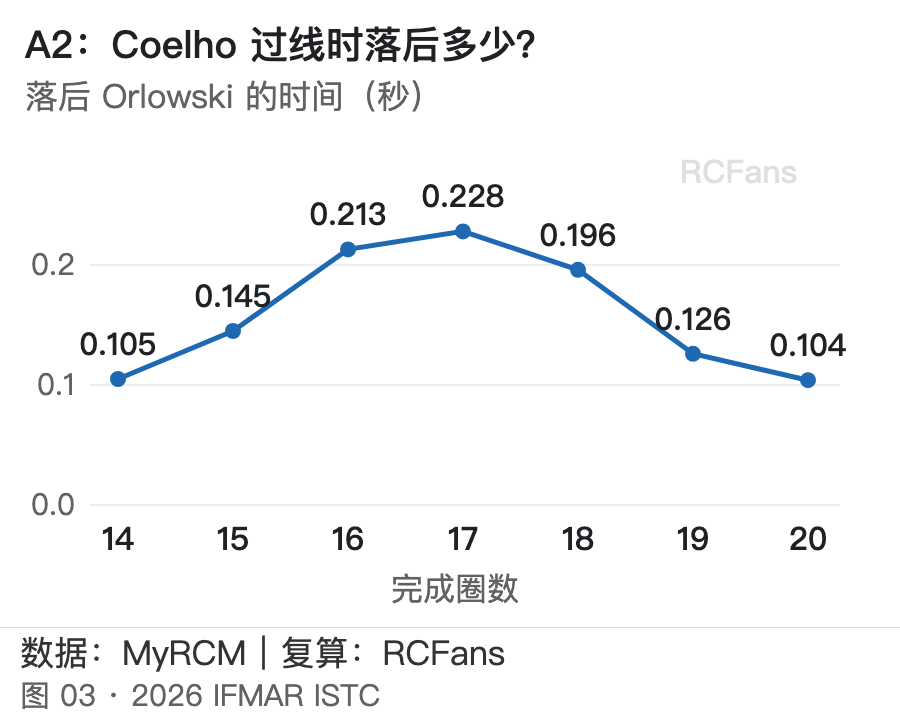
Figure 3 | At the end of laps 14–20 of A2, Coelho's deficit to Orlowski first grew from 0.105 s to 0.228 s, then shrank back to 0.104 s. The closing was not continuous. Data from official timing.
Before the A2 collision, Coelho still had a chance to attempt a pass. However, similar lap times and running close behind do not guarantee that he would have completed a pass in the remaining laps. Nor can the gap at the timing line be read directly as his reaction time in the incident corner. A1 lap chart · A2 lap chart
The 5-second penalty and the lap deduction
The A2 penalty needs to be looked at in two steps.
The first written IFMAR decision published after the race gave Coelho a 5-second penalty, for failing to comply with referee instructions: the notice states that the referee issued instructions to car No. 2 and that the driver did not follow them. Adding five seconds to his official race time would drop Coelho from first to third in that race, making Rheinard the A2 winner.
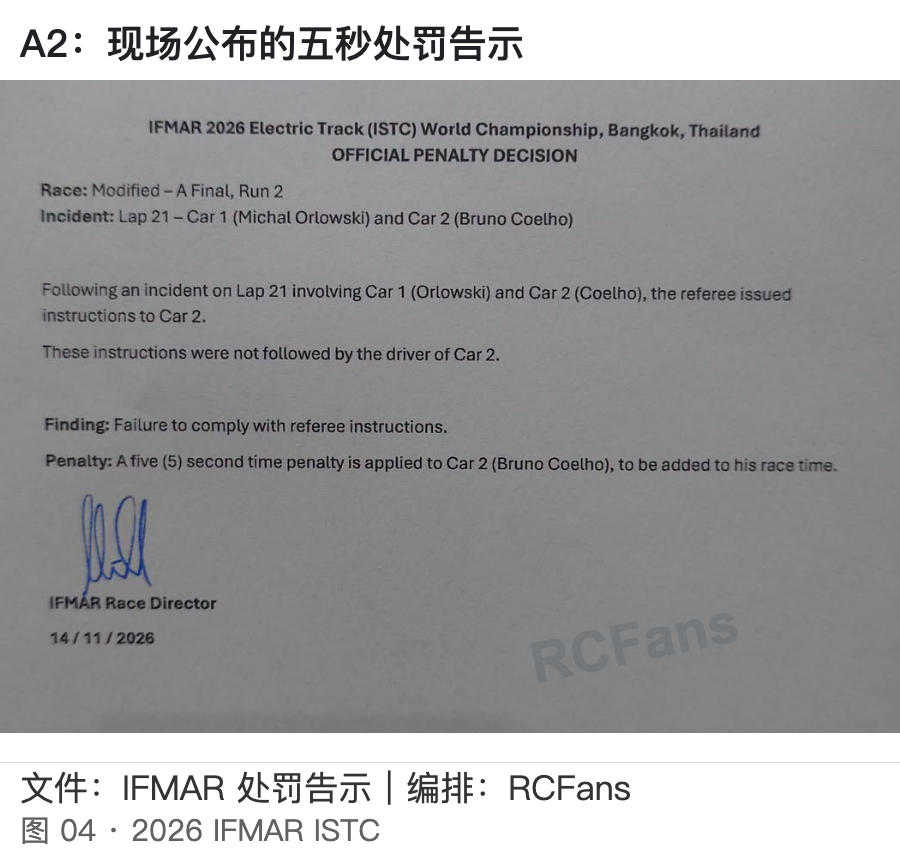
Figure 4 | The decision first posted at the event: a 5-second penalty for car No. 2 for failing to comply with referee instructions. The photo keeps the text of the decision, the signature and the date.
Red RC's report at the time also said the referee had initially called the penalty on car No. 1 by mistake, which was only noticed after the race. How this fits with the notice's statement that instructions were given to car No. 2 needs to be checked against the full race calls and any correction records.
RCFans has not been able to confirm from the available footage a clear stop or Stop & Go instruction directed at Coelho. “Failing to comply with referee instructions” is the event's written finding; how the instruction was conveyed has not been independently verified by us. We would welcome IFMAR publishing a fuller explanation of the decision and the record of the instructions given at the time.
If Coelho had stopped after the collision to give the position back to Orlowski, that could be a remedy, but it would not mean the collision itself was not an infringement. Our reading is this: if the referee had asked him to wait and give the place back, and he had done so promptly and correctly, he should not then be penalised for failing to follow that instruction; if the instruction was a Stop & Go, stopping on his own to wait would not automatically count as serving it. Because the full instruction has not been verified, we cannot say that giving the place back would certainly have avoided a penalty. Relevant rules: IFMAR General Rules 1.14.13, 1.14.20–1.14.23
After learning the A2 result, Rheinard said the 5-second penalty was too light, referring to an incident at Bakersfield in 2024 and saying that the same thing had now happened to Orlowski twice. Drivers are entitled to comment on penalties, but in RCFans' view linking the two events requires separate evidence for each; a dispute from two years ago cannot replace an assessment of this collision in Bangkok. The specific infringement and penalty are for the event officials to decide under the rules that apply here.
After A3, the final result was changed to a one-lap deduction. Coelho's A2 result went from 22 laps to 21, keeping his time of 5:08.326, and he dropped to tenth in that race. According to Red RC's post-event report, a formal protest was lodged with the fee and officials were called to meetings; the report explained the lap deduction as an application of the rule covering the final two laps of a race.
RCFans checked the IFMAR General Rules: rule 1.14.22 provides that driver infringements during the final two laps incur a one-lap penalty or are referred to the international jury, which sets the penalty after examining the incident. This presupposes that an infringement has been found; not every contact automatically leads to a lap deduction. Rule 1.14.23 separately covers Stop & Go penalties not served within three laps. IFMAR General Rules, page 11
In the event's official WhatsApp announcement group, a team managers' briefing summary marked for the 14 November finals day states that drivers must follow referee instructions immediately and promptly redress an incident when told to do so; that Stop & Go penalties may be applied during racing; and that post-race penalties may be more severe. The summary stresses following instructions and prompt redress; it does not say that every collision requires a voluntary Stop & Go, nor does it set out specific penalties.
Friends at the track and fellow media had earlier mentioned a requirement to take a voluntary Stop & Go; whether more specific verbal guidance was given still needs to be checked against the full record. For A2, what is still missing is which car the referee instructed and how, whether that call was corrected, the specific rule used for the initial 5-second penalty, and the full text of IFMAR's final lap-deduction decision.
These records matter for making the penalty process clear, and they should not be confused with the question of intent. The initial 5-second penalty stopped Coelho from wrapping up the title in A2, but it did not end his title chances before A3: a win in A3 would still have been enough for the title. In the end, he retired on the first lap of A3. Electric Track Rules, rule 1.6.3
A3: from an early attack to a multi-car collision
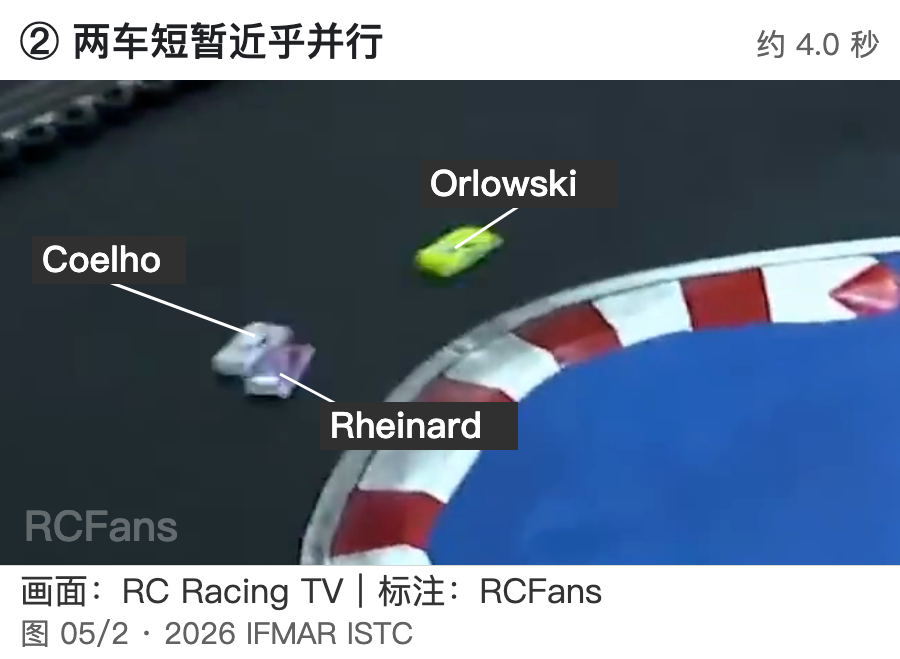
Rheinard attacked Coelho early in A3. About four seconds into the race he came alongside Coelho on the inside, riding the kerb; the two cars were very close and there may have been side contact, but Coelho stayed ahead. Rheinard did not complete the pass and kept chasing.
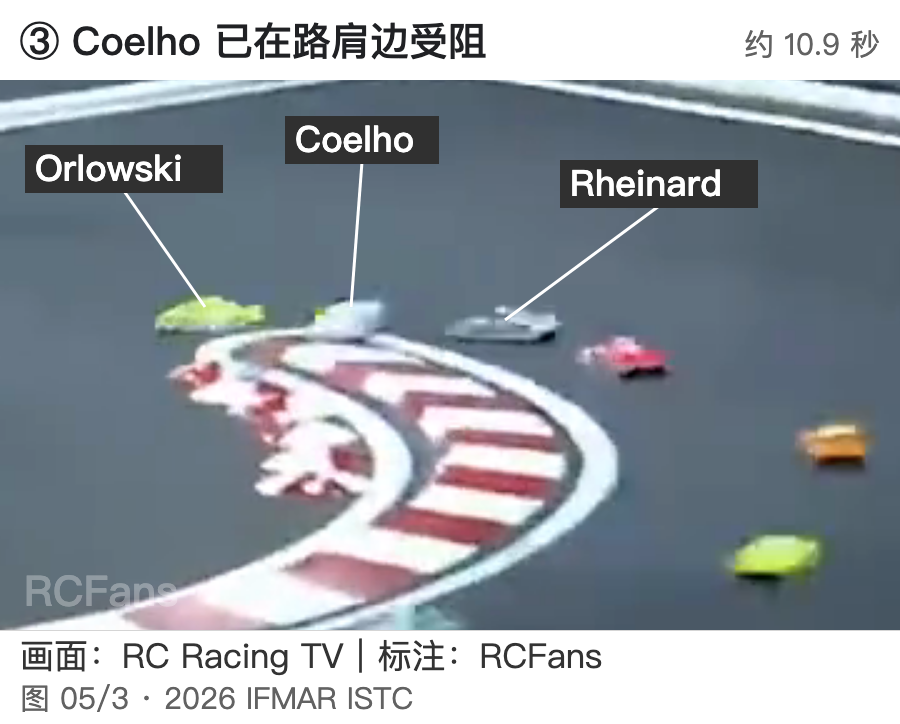
About 11 seconds into the race, Coelho closed on Orlowski from the inside. The two cars drew close near the kerb of the long left-hander, after which Coelho's car was clearly unsettled and held up; Rheinard then arrived and made contact, and cars further back also ran into the incident. Coelho did not complete a full timed lap. Orlowski continued and won A3.
① Rheinard attacks on the inside · about 3.8 s into the race
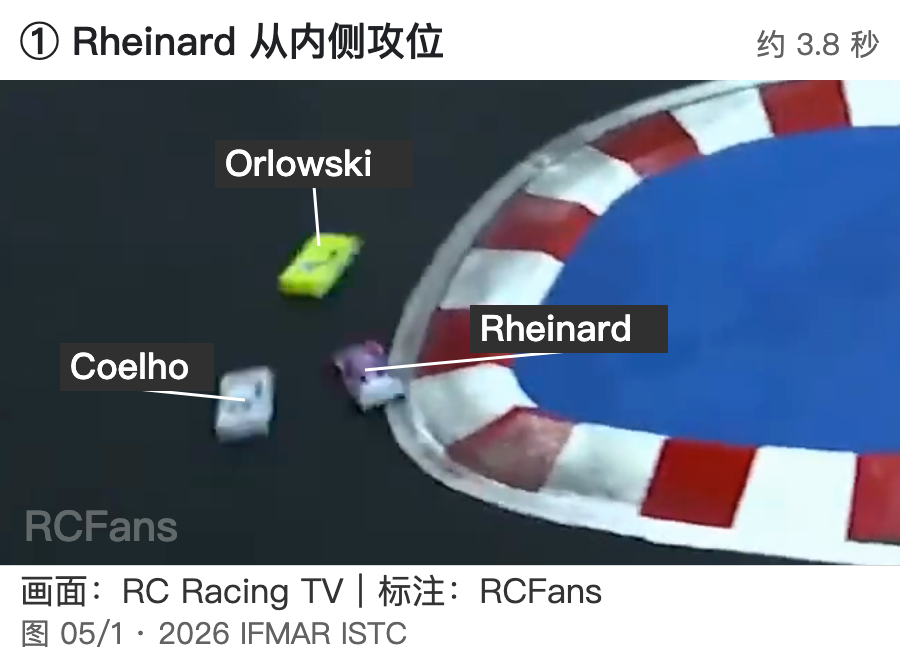
② The two cars briefly side by side · about 4.0 s
③ Coelho already held up at the kerb · about 10.9 s
④ Rheinard then joins the contact · about 11.1 s
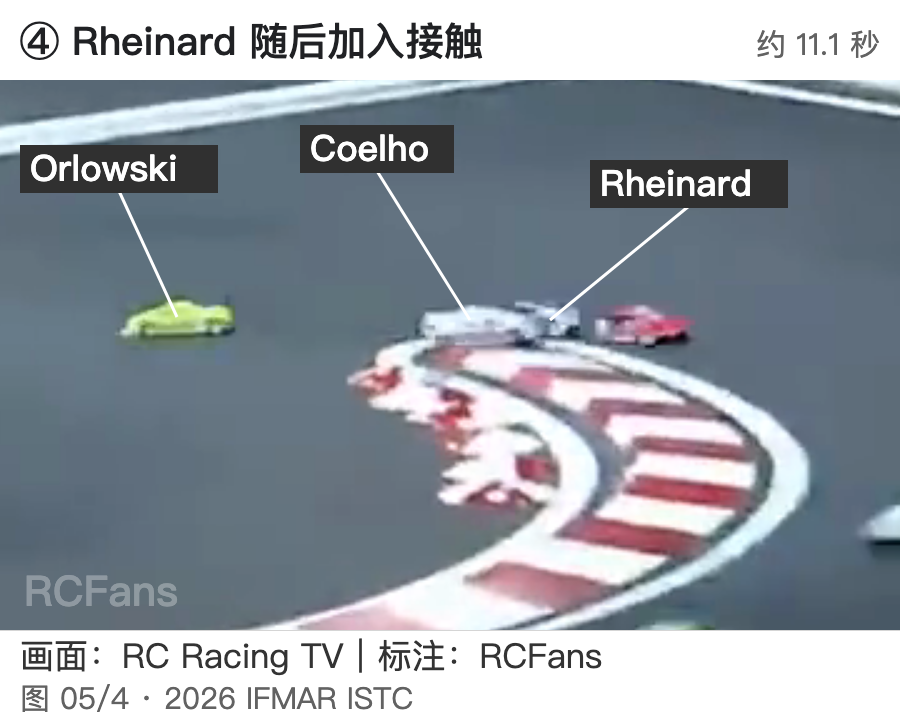
Figure 5 | The first two panels show the move on the inside about 4 seconds in; the last two show the incident about 11 seconds in. Coelho was already held up near the kerb when Rheinard made contact. The two moments are about 7 seconds apart.
In his post-race interview, Rheinard said he had wanted to try to pass Coelho at the start and then follow as closely as possible. He acknowledged that the two cars touched, but said he believed Coelho had first made contact with Orlowski ahead, which led to the chain collision. This is his post-race account.
According to Red RC, Rheinard served a Stop & Go for the first-lap contact with Coelho. Official timing shows his third lap at 17.084 seconds, about three seconds slower than the previous lap, consistent with that report. A3 official timing
Orlowski's first complete lap in A3 was 14.985 seconds, about 1.35–1.38 seconds slower than in A1 and A2, but that lap includes the long left-hander incident involving Orlowski, Coelho and others, so the lap time alone cannot show whether he deliberately slowed.
Comparing the same track markers across the three races on video, the section before the long left-hander incident also took him longer than in the previous two races. This is a reading from the video, not official sector timing, and the available material does not explain why he was slower.
Cars further back arrived at the two stricken cars, and some went round the outside. Cars flipping and hiding one another make some of the contact points impossible to identify.
On the post-race question of whether anyone deliberately targeted Coelho in A3, RCFans applies the same standard of evidence as for A2.
The available evidence is likewise not enough to conclude that any driver caused a collision on purpose in A3, nor to support claims that drivers worked together to take Coelho out.
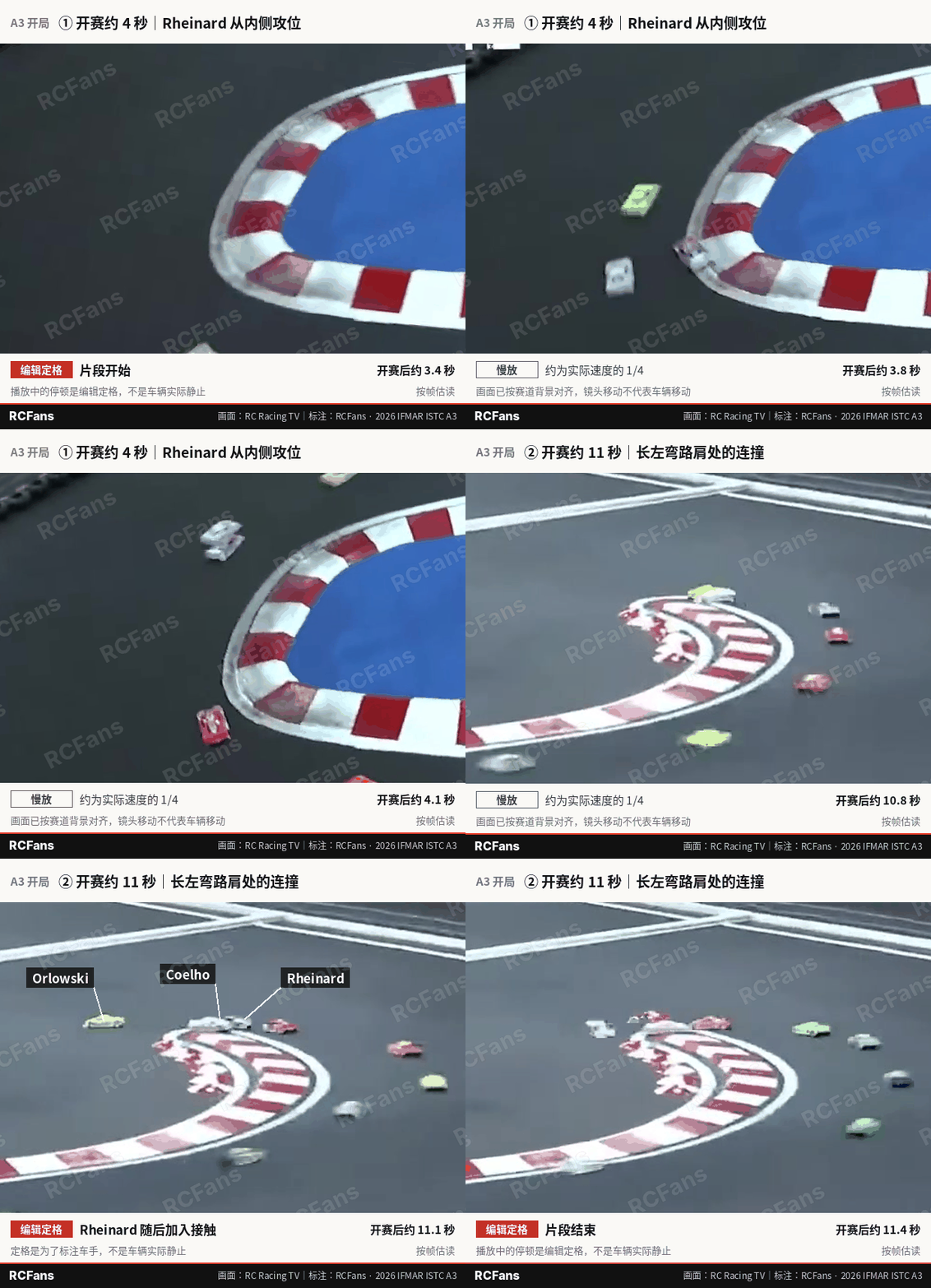
Two moments from the start of A3 in slow motion (about 1/4 speed). Pauses at the start and end of each clip and where drivers are labelled are editorial freezes and do not mean the cars stopped | Footage: RC Racing TV | Labels: RCFans
That Coelho was held up first and Rheinard made contact afterwards does not prove the car behind could not have avoided him, nor does it remove driving responsibility. As with A2, whether a penalty is needed should be judged on the specific actions and the applicable rules.
Two decisive wins in SPEC
The IFMAR 1/10 electric touring car SPEC class was just as competitive. Lukas Ellerbrock won four of the six qualifying rounds to take TQ, then won A1 and A2 to seal the world title with a race to spare.
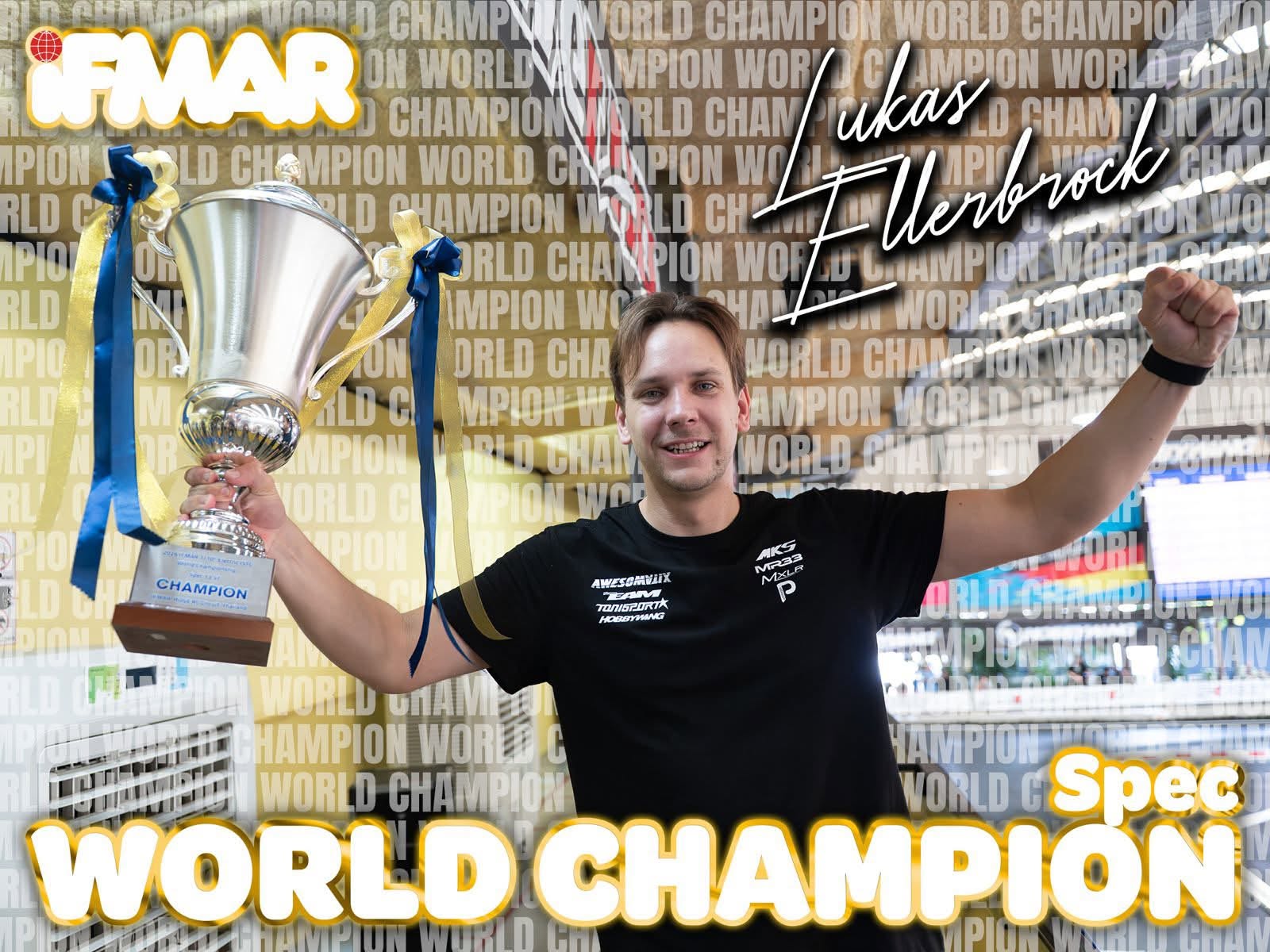
In the two A-mains he beat Olivier Bultynck to the line by 0.361 and 0.151 seconds. The margins were small, but both times Ellerbrock held the lead to the flag. Bultynck went on to win A3 and finish second overall; Max Machler was third, completing an Awesomatix podium sweep. SPEC A1 · SPEC A2
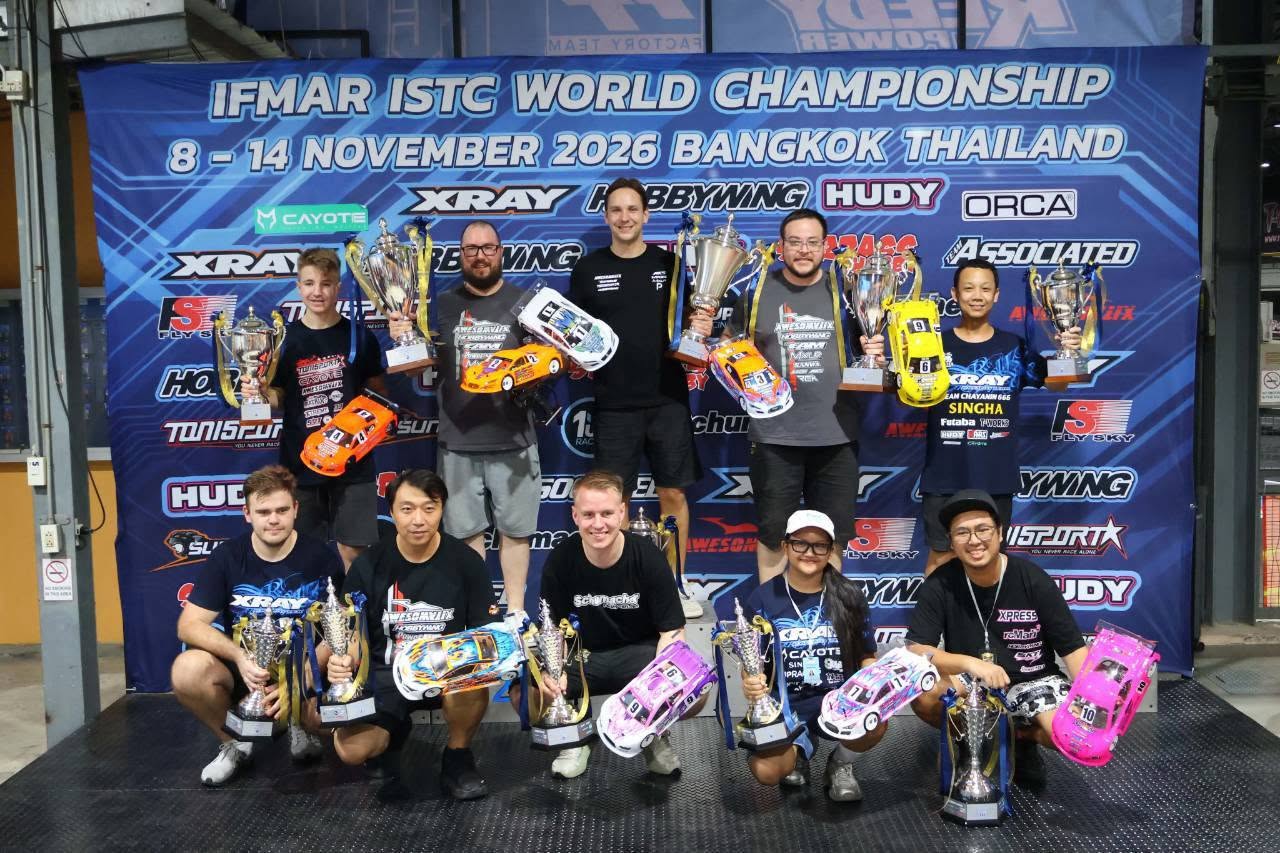
SPEC A-main drivers on the podium
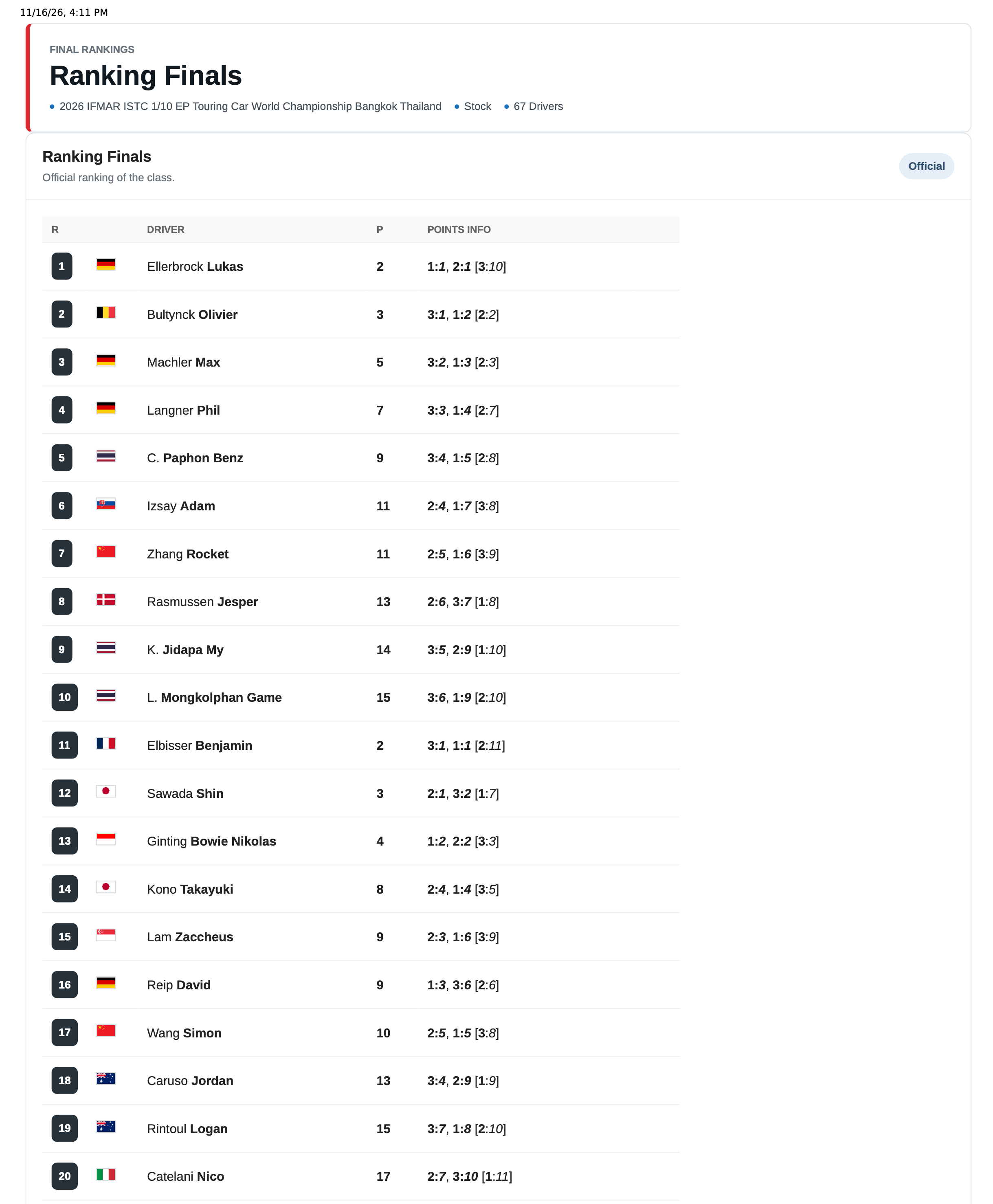
SPEC final ranking | Source: MyRCM official results
In an interview with Red RC, Ellerbrock said he had been confident from practice onwards in how his car performed over five minutes. There was pressure before the race, but in the A-mains he focused on driving and finished two clean races. He also stressed how small the gaps between competitors were, with everyone pushing each other to the limit.
This year's SPEC class used 13.5T brushless motors with ESCs in Blinky mode, which rules out electronic timing advance such as boost and turbo. MyRCM lists the class as Stock. With power limited, small lap-time differences, consistency and car preparation still decided the result. Event Stage 2 document, page 10 · Electric Track Rules, rule 2.2.7
Also worth noting: Rocket Zhang (Zhang Fangzhou) from Shanghai, China, made the SPEC A-main and finished seventh, a proud result for Chinese RC racing.
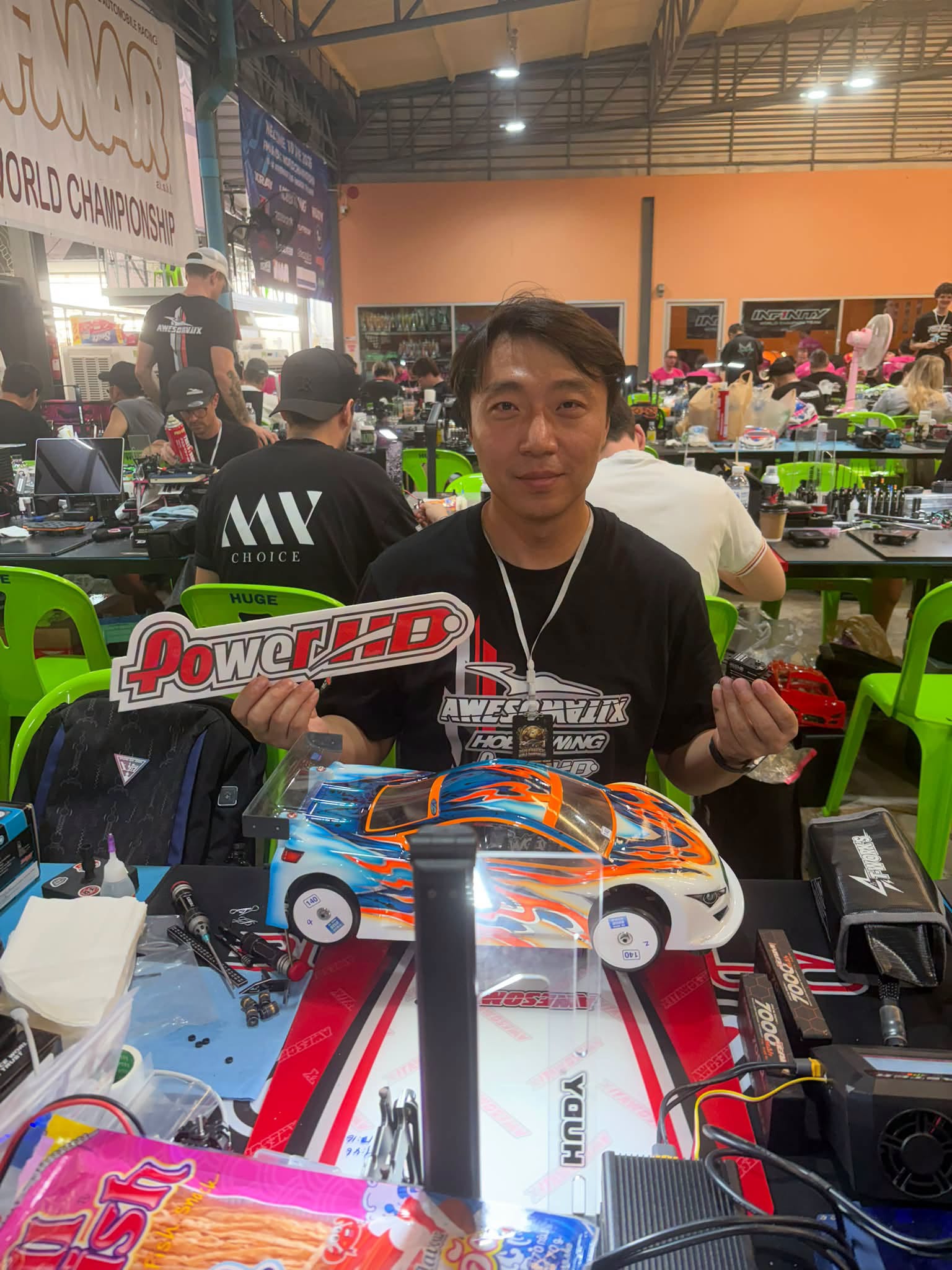
Rocket Zhang (Zhang Fangzhou) at the track in Bangkok
Making the penalty process clearer
One concrete question this World Championship leaves is how to make the whole penalty process understandable for drivers and spectators. In A2, a 5-second penalty was posted at first, and the final result became a one-lap deduction. Beyond knowing that the positions changed, people need to understand what instruction the referee gave to which car, what the 5-second penalty was based on, and why it was later changed to a lap deduction.
The organisers did publish team managers' briefing summaries in the official WhatsApp announcement group, stating that drivers must follow referee instructions immediately and promptly carry out any remedy they are asked to make, and warning that post-race penalties could be more severe. These texts help explain what was expected at the track. For A2, RCFans still hopes to obtain fuller records of the instructions and decisions so that the handling can be reconstructed clearly.
The IFMAR General Rules already require formal warnings and penalties to be recorded and published with the results, and referees to give reasons when they issue warnings or instructions. Building on these requirements, events can further improve how decisions are recorded and explained. IFMAR General Rules 1.14.12, 1.14.18
RCFans suggests setting out the stop-and-go procedure in writing before the event and making it easy to consult: what a driver should do after receiving an instruction, where to stop, for how long, and how to rejoin. When a penalty is issued during a race, the lap, car number, reason and instruction should be recorded; if a call is made in error, it should be clearly corrected and the correction recorded. When a penalty is changed after the race, the decision should state what infringement was found, which rule applies and why the original decision was changed.
Video can support these records. A World Championship could place fixed cameras at key corners and, where possible, keep a clear recording of race control announcements, so that incident footage, instructions and timing can be matched up. At local events, keeping continuous footage alongside complete results and penalty records also helps post-race review.
With this information properly recorded, drivers can understand why they were penalised, spectators can understand why results changed, and the referees' work can be assessed more fairly.
Sources and method
RCFans checked all 642 timing records for the 10 drivers in the three Modified A-mains, reviewed key sections frame by frame and compared lines across laps, and cross-checked against the IFMAR rules, driver interviews published by Red RC, and feedback from drivers, fellow media and friends at the track.
The team managers' briefing summaries and event notices come from the official WhatsApp announcement group provided by the organisers, and are based on the text in the group and available screenshots.
Data processing, calculation and cross-checking used several analysis tools with AI assistance, followed by multiple rounds of human review; RCFans is responsible for the editorial conclusions. Only one usable camera angle was available for the key collisions, and no throttle, brake or steering data is available. Paths in the figures come from image analysis and video timings are estimates; they cannot replace telemetry. We keep the original material and a record of corrections, and we will update this report if new evidence emerges that changes our assessment.
Interviews via our media partner Red RC; results and lap times from MyRCM; rules from IFMAR. Race footage from RC Racing TV; figures prepared by RCFans. Thanks to Huge RC Circuit and to the drivers, fellow media and friends who provided material and feedback from the track.
After the event, RCFans spent more than 48 hours of time and computing resources organising the data, running AI-assisted cross-analysis and multiple rounds of human review, and repeatedly checking with friends at the track. We hope this work will be a useful reference for drivers, brands and organisers, help World Championships and local events keep improving, give racing and hobby RC enthusiasts a better experience, and bring more people into the sport.
This article was first published in Chinese on RCFans.com. The English version is a translation; if the two differ, the Chinese original is the reference text.